
Why Is My Gutter Leaking at the Joint?
And Why the Repair Is the Cheap Part
Because metal moves. Every sunny day your spouting gets longer, every night it gets shorter, and a joint held together by sealant alone slowly gives up.
If a gutter is going to leak somewhere, the joint is the favourite. Not the middle of a length, not the brackets — the place where two pieces meet.
The Reason Is Boring and Unavoidable
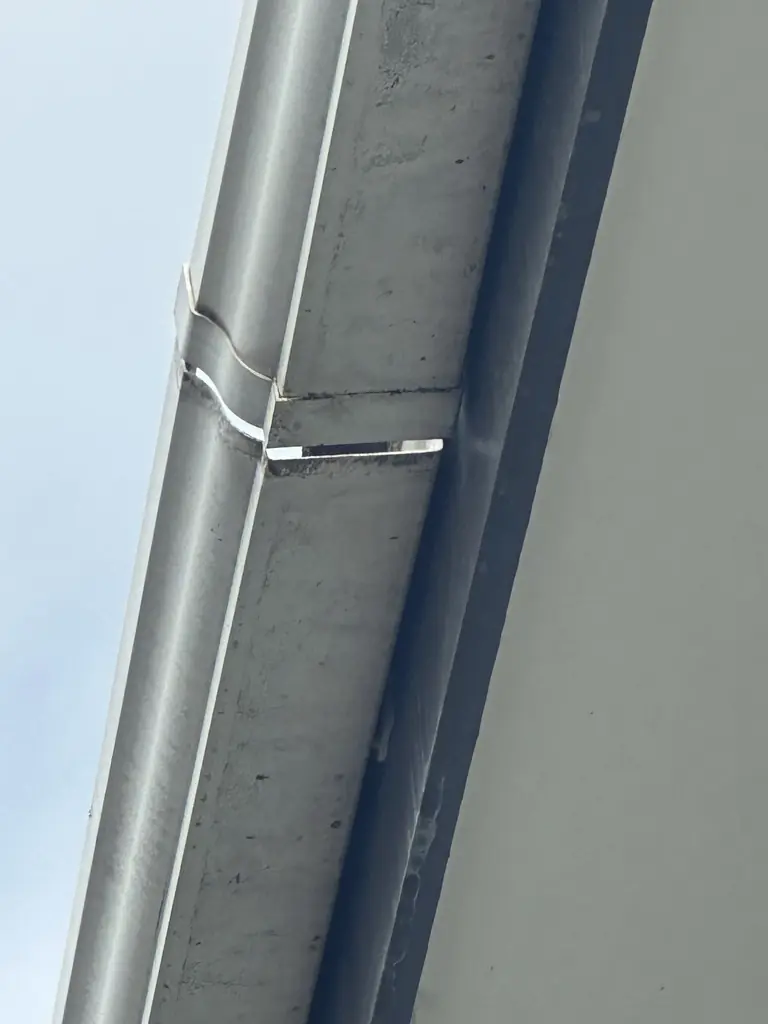
Metal expands when it heats and shrinks when it cools. On a long run of spouting in an Auckland summer that is real movement, happening twice a day, every day, for years. A joint that is only sealed — not fixed — creeps a fraction with each cycle. Eventually the two lengths have slid far enough apart that water running along the gutter finds the gap and goes over the side.
How to Spot It From the Ground
You do not need to go up. Watch the gutter in heavy rain and look for the point where water comes over the edge rather than running along it. That point is your fault. Nine times out of ten it is one of three things:
- A joint that has crept apart — water escapes at one specific spot
- A blocked outlet — the gutter fills and overflows along a whole stretch
- A section that has sagged below the fall — water pools instead of running
Even in dry weather there is usually a clue: a dark stain running down the cladding directly below the leak.
Why Glue Alone Comes Back
It is tempting to run a bead of sealant into the gap and call it done. It will hold — for a while. But adhesive alone is exactly what failed the first time, and the same daily movement will work it loose again in a few summers.
The fix that lasts is to pull the joint back together, bond it, and put a screw through it. Then the joint is held mechanically and the sealant is only doing the sealing, which is all it was ever good at. That is the difference between a repair and a postponement.
Sometimes the Answer Is an Expansion Joint, Not a Repair
Worth knowing: not every joint in a gutter is a weak point. Some are there deliberately.
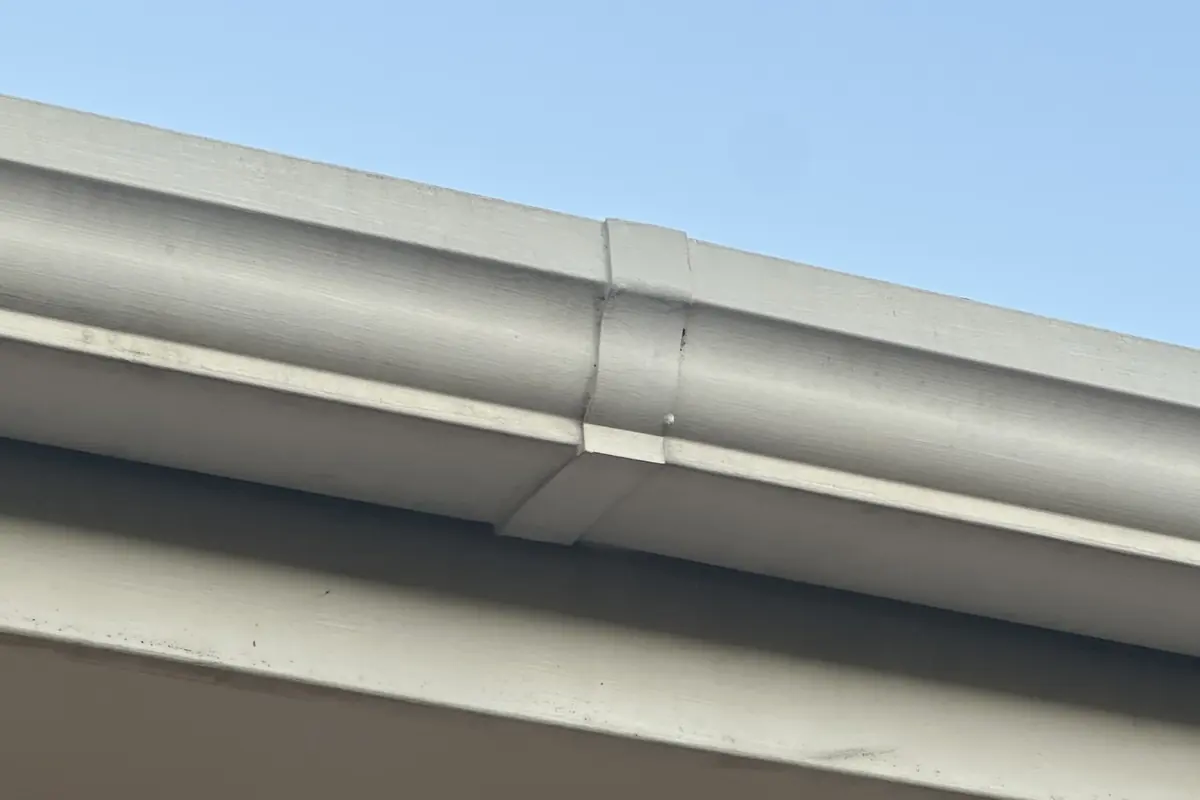
On a long continuous run, the daily expansion and contraction adds up to more movement than an ordinary joint can take. So an expansion joint gets fitted on purpose — a joint built to slide, with a seal designed to stay watertight while the two lengths move against each other. It gives the metal somewhere to go.
Here is why that matters when yours keeps leaking. If a long run has no expansion joint, the movement does not disappear — it has to be absorbed somewhere, and it gets absorbed by the ordinary joints and the brackets. That is exactly how a joint creeps apart. Repair it and the same forces are still there, working on the same spot.
So if you have a long gutter that has failed at a joint more than once, the honest answer may not be another repair. It may be that the run needs an expansion joint fitted. How long a run can go before it needs one depends on the material and the manufacturer's own spec, so it is worth asking rather than guessing.
The Part That Actually Costs Money
Here is the honest bit, and it surprises people. The repair takes minutes. What you are paying for is getting safely to it.
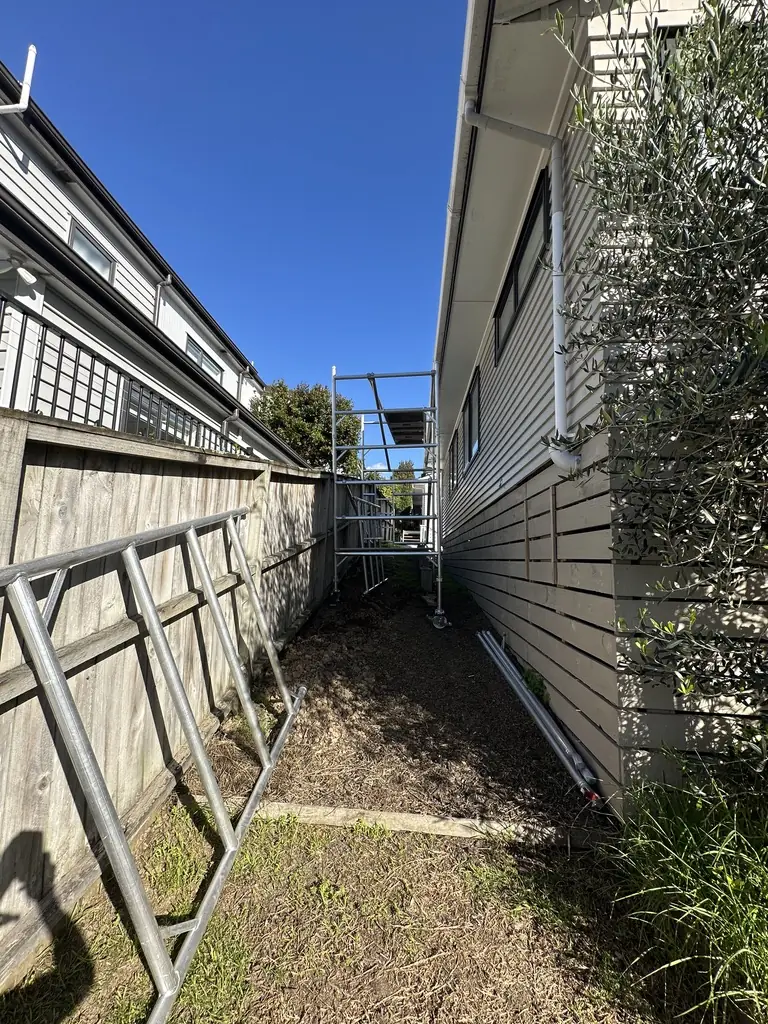
On this Howick house the gutter ran along a side passage barely wider than a wheelbarrow, boundary fence on one side, and it was high. There is no safe way to foot a ladder in there and still work with both hands. So the scaffold went up, the joint got fixed, and the scaffold came down.
$380, an hour and a half, scaffold included. A gutter you can reach from a properly footed ladder on flat ground costs less — the fault is the same, the access is not.
One Thing Worth Doing While Someone Is Up There
If the access gear is already set up, that is the cheapest it will ever be to look at the rest of the run. From the platform you can see silt, sagging brackets and a blocked outlet — none of which are visible from the ground. Getting those sorted in the same visit costs a fraction of coming back for them later.
See the full project — the joint, the scaffold and the repair →
You May Also Need
Gutter Dripping Down the Wall?
Tell me roughly where it comes over in heavy rain, and how easy the spot is to get to — that is most of the quote.
Request a Gutter Repair Quote
Three details are enough. We’ll call or message to discuss the rest.
Thanks — your request has been sent.
Rinat will call or message to discuss the job and cost.